
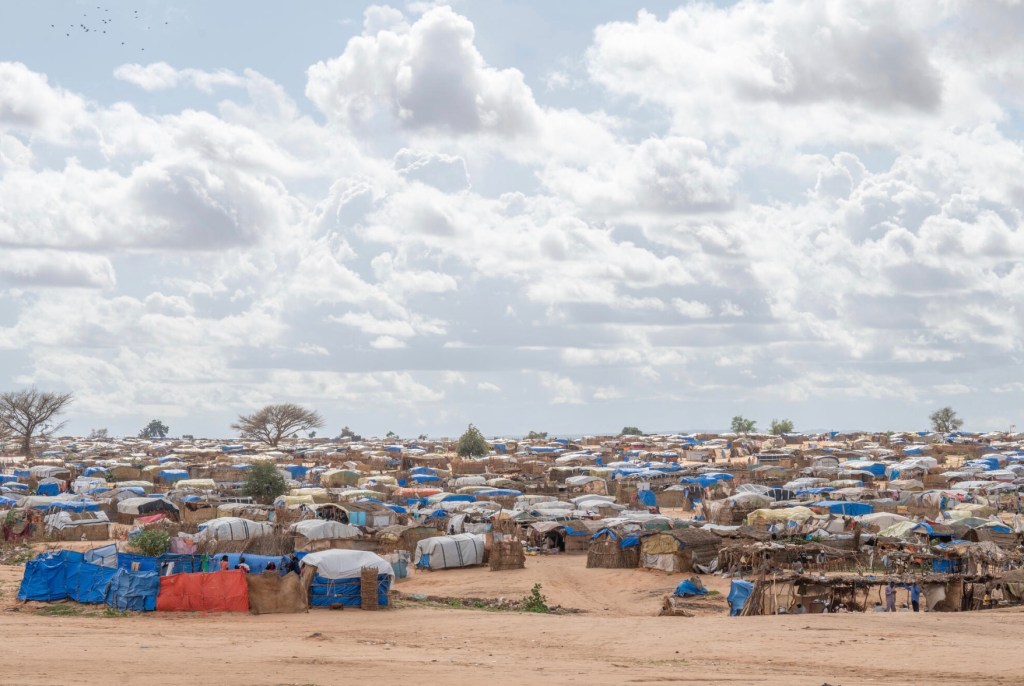
Since April 2023, Sudan has been engulfed in a deepening crisis fueled by intense clashes between the Sudanese military and Sudan’s Rapid Support Force. The war’s impact has been absolutely devastating, with at least 26,000 thousand Sudanese dead and over 14 million people displaced from their homes, making it the world’s current worst internal displacement crisis.1,2 An estimated 6.7 million people are at risk of gender-based violence, the bulk of which are displaced, refugee and migrant women and girls.3 The scale of human loss and suffering is unquantifiable, with continued attacks on civillian infrastructure, deteriorating health care system and intensified sexual violence.4 As the conflict escalates, the human loss and suffering continues to aggravate in the region.
Prior to the current conflict, Sudan was already experiencing its highest demand for humanitarian assistance in decades. The fighting has only exacerbated the challenges Sudan is already facing, such as additional conflicts, disease outbreaks, fragile healthcare system, economic and political instability and climate-induced disasters.5
The war in Sudan has unleashed widespread violence, with the Sudanese army responsible for 4,805 attacks, accounting for a staggering 54% of all documented incidents and the Rapid Support Forces behind 3,069 attacks, or 34% of the total. The remaining 12%, 1,068 attacks, are attributed to groups such as the Darfur Communal Militia, Darfur Arab Militia, Twic Clan Militia and other smaller factions.6 The RSF’s occupation of strategic areas in the capital, Khartoum has led to severe shortages of essential supplies and services. The involvement of various militias has further complicated the situation, contributing to instability and suffering in the capital.5
Even before the eruption of the current war, Sudan has grappled with ethnic violence and mass displacement. In 2003, nearly 300,000 people from North Darfur fled to the Zamzam camp in search of safety. For years, international aid organizations and United Nations agencies have provided critical humanitarian and medical support to these vulnerable populations. However, the escalation of the war has forced the withdrawal of all international aid groups from the region, leaving camp residents without access to lifesaving services and exposing them to the full brunt of the conflict’s devastation.
According to the World Health Organization, there have been over a 100 attacks on health facilities in Khartoum, Sudan’s capital, leaving only one functioning hospital in Khartoum north to serve its population and those of neighboring cities.7 This further compromises the already very fragile healthcare system in place.5 Healthcare facilities, and access to them, must be protected in accordance with international humanitarian law.8
Residents of camps across North Darfur are forced to face the devastating impacts of malnutrition, inadequate healthcare, and poor water sanitation. Famine was officially confirmed in the Darfur region by the Famine Review Committee in August 2024.9 The humanitarian crisis reached a critical point in October 2024, when supply blockades compelled Médecins Sans Frontières (MSF) to halt care for 5,000 malnourished children in the region.10 The crisis is particularly severe among young children, with 40% of those aged 6 months to 2 years suffering from acute malnutrition, and 15% classified as severely malnourished. These figures highlight the critical shortages of food and medical aid. Compounding the crisis, the lack of access to clean water has left camp residents no choice but to rely on contaminated swamp water, leading to fatal cases of diarrhea and worsening the humanitarian emergency.10
Amid this dire situation, MSF has become the lifeline for North Dafur’s camps.11 MSF operates the only health clinic in Darfur’s Zamzam camp, stretched far beyond capacity and struggling to manage the overwhelming number of cases with severely limited resources. The absence of additional medical support has left countless ill and injured camp residents without care, as MSF is unable to meet the growing demand for lifesaving assistance.12
MSF finds itself confronting a critical shortage of resources and funding necessary to sustain the ongoing care for individuals residing in camps across North Darfur. Serving as the sole provider of pediatric health care and food, the organization is unable to serve all those in need. Imperative action from international organizations is more than necessary to prevent further harm to the vulnerable populations of Sudan.
References
Disease, Hunger Drive “Invisible” Death Toll In Sudan War – Health Policy Watch. November 14, 2024. https://healthpolicy-watch.news/disease-hunger-drive-invisible-death-toll-in-sudan-war/
2. OCHA. Sudan. November 3, 2024. https://reports.unocha.org/en/country/sudan/
3. Sexual violence and conflict in Sudan: A war on the bodies of women and girls. https://www.unfpa.org/news/sexual-violence-and-conflict-sudan-war-bodies-women-and-girls
4. MSF report reveals catastrophic toll of violence in Sudan | MSF. https://www.msf.org/msf-report-reveals-catastrophic-toll-violence-sudan
5. Crisis in Sudan. Doctors Without Borders / Médecins Sans Frontières (MSF … May 19, 2023. https://www.doctorswithoutborders.ca/crisis-in-sudan/
6. Civil War in Sudan. Global Conflict Tracker. https://cfr.org/global-conflict-tracker/conflict/power-struggle-sudan
7. Administrator. Sudan surpasses 100 attacks on healthcare since 2023 armed conflict began. World Health Organization – Regional Office for the Eastern Mediterranean. http://www.emro.who.int/media/news/in-sudan-there-have-been-more-than-100-attacks-on-health-care-since-the-armed-conflict-began.html
8. Protection of Medical Services Under International Humanitarian Law: A Primer | Doctors Without Borders – USA. https://www.doctorswithoutborders.org/latest/protection-medical-services-under-international-humanitarian-law-primer
9. Famine confirmed in Sudan’s North Darfur, confirming UN agencies worst fears. https://www.unicef.org/press-releases/famine-confirmed-sudans-north-darfur-confirming-un-agencies-worst-fears
10. abubaker. Sudan: Supply blockade forces MSF to stop care for 5,000 malnourished children in North Darfur. Doctors Without Borders / Médecins Sans Frontières (MSF … October 10, 2024. https://www.doctorswithoutborders.ca/sudan-supply-blockade-forces-msf-to-stop-care-for-5000-malnourished-children-in-north-darfur/
11. OCHA. Sudan Humanitarian Update (1 November 2024) [EN/AR] | OCHA. November 1, 2024. https://www.unocha.org/publications/report/sudan/sudan-humanitarian-update-1-november-2024
12. abubaker. Sudan: Catastrophic situation in Zamzam camp, every effort must be made to finally deliver food, medicines and essential supplies to blockaded and starved communities. Doctors Without Borders / Médecins Sans Frontières (MSF … September 13, 2024. https://www.doctorswithoutborders.ca/sudan-catastrophic-situation-in-zamzam-camp-every-effort-must-be-made-to-finally-deliver-food-medicines-and-essential-supplies-to-blockaded-and-starved-communities/
 McMaster Friends of MSF